19 Tips for Driving Traffic to Your Blog
By Denise Wakeman
Published April 8, 2010
It’s the the perennial quest. How can you get more traffic to your site?
After all, without a steady stream of traffic to your blog, there’s little opportunity to engage your audience and convert readers to raving fans.
Methods change and evolve over time. When I wrote my first “how to drive traffic” post about five years ago, the list looked a lot different. There was no Twitter, no Facebook, no social sharing buttons, and no retweet button.
Yet some methods I advocated back in 2005 still work, so think of this as a refresher if you’re already employing all the social tactics for driving traffic. You would be surprised at how many people don’t actually take the time to implement a variety of tactics. Maybe you can pick up a few new ideas or implement some old ideas you may have overlooked.
This list is in no way complete. I invite you to add your favorite tips in the comment section.
First, the tried and true:
#1: Publish as frequently as possible
The more frequently you post, the more traffic you get because the search engines are indexing your content more frequently. Of course your content has to be compelling as well, but that goes without saying, right?
#2: Pay attention to the headlines (blog post titles)
Using numbers (see title of this blog post!) usually generates good traffic. Titles with “how to” also attract a lot of traffic.
#3: Send an email broadcast
Send email to your list when you have a great blog post you want to share. Ask for comments to encourage engagement and interaction.
#4: Add a link in your email signature
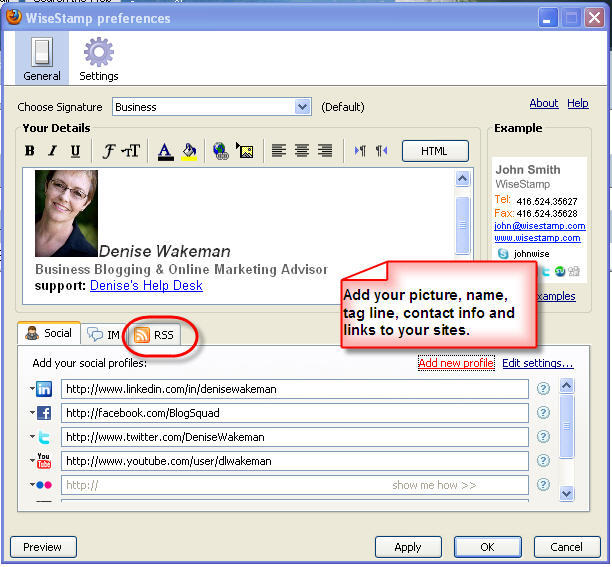
If you use web-based email like Gmail, add WiseStamp to your email signature so you can include links to your blog. Add your blog’s RSS feed so your recent posts are always featured in your emails. WiseStamp works with web-based email services including Gmail, Hotmail, Yahoo mail and AOL.
WiseStamp adds all your links to your email signature and is simple to install and edit.#5: Include multiple subscription options on your blog
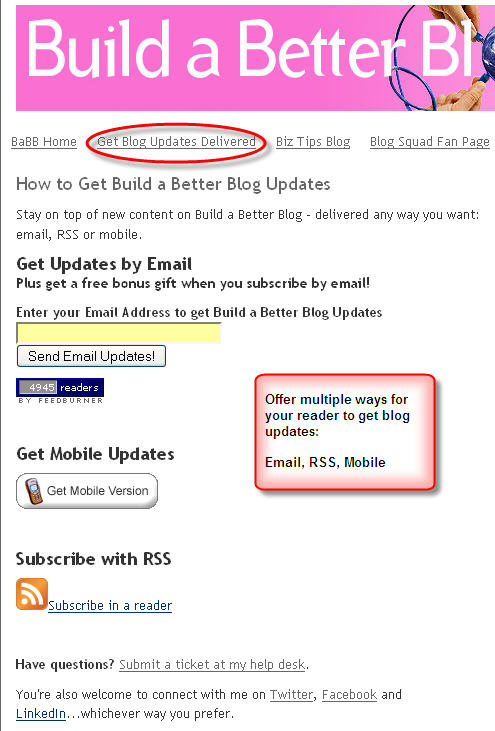
Most blog platforms have RSS feeds built in, but don’t forget to add an email subscription option as well. Email is ubiquitous and if you only offer RSS, you lose a huge opportunity for people to get your content and become regular readers. Email subscription services include Feedburner, Feedblitz and AWeber, to name a few.
Give your readers multiple options for getting your blog updates.#6: Try article marketing
Article marketing is a powerful way to attract traffic. Post your articles at EzineArticles.com and include a link to your blog in your author resource box. Also set up your author account to automatically send a tweet when you post new articles. That drives traffic to your article which drives traffic back to your blog.
#7: Comment on blogs in your industry
This is all about outreach and boosting your visibility on complementary blogs. Target influential blogs, read them on a regular basis and then contribute to the conversation as appropriate. When you comment, you have the option to include the URL to your blog.
#8. Do some guest posting
Writing on other people’s blogs can introduce you to a new audience and create a surge of new traffic to your blog. You can find more information and a great resource for getting guest posting gigs here.
#9: Conduct surveys and polls
People love to give their opinion. Use Polldaddy or SurveyMonkey to ask your readers what they want or get their opinion. More often than not, those who respond will help spread the word, especially if you ask and/or offer a gift in exchange.
#10: Submit your blog to directories
While it’s debatable how much traffic you’ll get by having your blog in directories, it can’t hurt to be listed. Most definitely I would recommend you add your blog to Technorati, the largest blog directory on the web, and Alltop.com, a popular directory with the best of the best organized by topic.
Now the social media tips:
#11: Make a Google profile
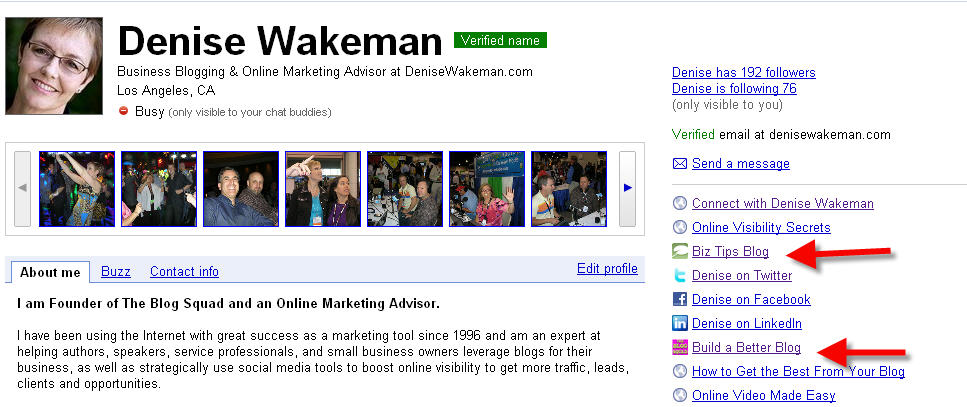
You can’t ignore Google. Set up your profile on Google and include links to your blogs and websites. Whenever someone does a search on your name, a link to your profile will be featured at the bottom of the first page of search results. You can include pictures, links to your blog(s), products, website, and social networks.
Build your profile on Google.com/profiles with links to your blogs.#12: Syndicate to Twitter
Use a plug-in like Twitter Tools (Wordpress) or an application like Twitterfeed.com to syndicate your new posts to your Twitter stream. Hootsuite, the Twitter management tool, also offers this function. TypePad has this option built into the platform as well.
#13: Syndicate to Facebook
Use the Facebook Notes application to pull your blog feed into your profile and/or fan page.
#14: Syndicate to LinkedIn
You can add three URLs (make sure one is your blog!) to your LinkedIn profile, as well as syndicate your content with the Blog Link application.
#15: Use Hootsuite
Use Hootsuite if you have multiple blogs to syndicate your new content to multiple platforms including your Twitter accounts, Facebook profile and fan page, LinkedIn and Ping.fm to broadcast to more sites for even greater reach.
#16: Distribute your video
Distribute your videos on all the video sharing platforms. Include a link back to your blog home page or specific blog posts that are relevant to the content in your video. TubeMogul is a free site where you can upload your video once and it will be published on up to 20 video platforms including YouTube, Vimeo, Blip.tv, and more.
Distribute your video to many sites with Tubemogul.com#17: Add the retweet button to your posts
Grab the plug-in or the code from Tweetmeme and make it super simple for your readers to click and share with their networks.
#18: Consider share buttons
There are many plug-ins and add-ons to add buttons to your blog that make it easy for readers to share your content on Twitter, Facebook, Digg, Delicious, Reddit, StumbleUpon, etc. Find the style that suits you and add it to the footer of your blog posts. The popular plug-in used on this site is Sexy Bookmarks.
#19: Use social bookmarking
Use sites like StumbleUpon, Digg and Delicious to share your content. When you have a particularly great post, ask your readers to help you out with bookmarking. Don’t overdo it, but if you think your post deserves some additional attention, don’t be afraid to ask.
OK, your turn. Are you using any of these tips with success? I know there are at least 100 more ways to drive traffic to your blog. Please add your tips to the list by commenting below.
Tags: alltop, artcile marketing, aweber, blip tv, blog, blog comments, blog directory, blog frequency, blog poll, blog survey, blog traffic, bookmarking, business blogging, delicious, denise wakeman, digg, email broadcast, email signature, ezinearticles, facebook, feedblitz, feedburner, google profile, guest posting, headlines, hootsuite, How To, linkedin, outreach, polldaddy, retweet button, rss, search engine indexing, share button, social media, social tactics, stumbleupon, subscription options, surveymonkey, technorati, tubemogul, tweetmeme, twitter tools, twitterfeed, typepad, video, vimeo, wisestamp, youtuve
Friday, April 9, 2010
19 Tips for Driving Traffic to Your Blog | Social Media Examiner


Saturday, April 3, 2010
Tips to Power Up Your Relationships in Blogging | Areview.Co.Cc
Blogging shrinks the world. Different people from different parts of the world are brought together through the blog. On the blog, making good conversations are rewarding as it brings more traffic, communication, interactivity, exchange of various views and opinions, and more importantly, it opens the door to building up effective relationships with other bloggers.
The blog can be used for personal reasons or it can be used for marketing purposes. No matter what intentions it is being used for, it can bring positive rewards and success. Therefore, it is essential to power up your relationships in blogging if you want to achieve great success on both fronts.
How can you go about doing it and achieving the success that you want for your blog and online business? Here are some tips that will guide and help you:
(1) Apply your voice effectively
The blog represents you. It requires a voice that speaks to the rest of the world in a manner that is both sincere and transparent. You will be able to win over the trust of others if you show that you have a listening ear too. This is one of the effective tips to power up your relationships in your blogging. People will be moved and will return to communicate more with you.
(2) Always be interactive
Blogging is intrinsically an interaction between two bloggers who would communicate views and opinions in a non-prejudiced way. Exchange of ideas increases the level of interactivity. Both bloggers get to learn from each other. This raises the level of confidence and trust that is so crucial to building the vital relationship needed in blogging.
(3) Show your love for feedback
In your blog, you will have the comments box. Encourage visitors to drop their comments on their visit to your blog. Comments will help you understand your blog better. You can then plan to make it work more effectively for your business. Sharing of views and requesting help will further draw your visitors closer to you.
(4) Aim to enhance your positive experiences
The blog provides the best opportunity for you to improve your positive experiences with other bloggers. Building the precious relationship will take some time; it will definitely grow naturally and progressively. Others will get to know you more and more in the future. You will thus be able to power up your relationships. Your positive experiences will cause the visibility of your blog to increase.
(5) Make yourself known to other bloggers
If you want to initiate, strengthen and grow relationships with others, you have to make yourself known first. You can achieve this via the feed. Others will develop a certain perception about you. They will be able to understand you better – your passions and personality traits through your blog and blog content.
(6) Aim to build mutual respect
In blogging, it is vital to build and strengthen the relationship between yourself and others. There must be the connection that will pave the way for future growth of your blog and business. One way that helps to power up your relationships in blogging is by means of links. Links prove effective especially when they infer that you have great content on your blog for your visitors to read and digest. Links indirectly are a measure of respect.
(7) Make full use of technology
Communication that is personalized is the main keyword in blogging. The blog is the platform to succeed in effective communication and useful contribution. Converse more with others who have the same interests. Now, there is Skype that provides the latest technology in real-time talk. Your relationship with others enters a new, refreshing and higher level.
(8) Use the email
The relationships that you have developed through your blog can be strengthened yet another level using the email. The email is simple and well-loved by many bloggers. It plays the role of extending the conversation from comments to your mail box. Through time, relationships will become stronger.
In conclusion, blogging provides many opportunities to build real and cordial relationships amongst bloggers. Provide your human touch and personalized voice, and you will be on the road to success in blogging.
For latest updates on how to increase traffic, raise page ranking, write effective articles and powerful squeeze pages, create explosive blog marketing system, learn about viral marketing, and bring in massive income from your internet marketing business, please Click here
Webmaster: Jeremy Long Chia Teik.
Recent Entries
- Latest Online Money Making Auctions
- Latest Online Money Making Auctions
- 5 Blogging Plugins You Must Use
- 10 Essentials To Creating A Blog That Pulls In Money Like a Magnet
- ELEVATORS SUCK – The good, the bad, and the awkward.
- JW & Blaze – Palance (Official Music Video) HD
- Victoria’s Secret Fashion Show 2005 3/4
- Latest 11.6Inch, Acer, AS14108414, Aspire, Battery, Blue, Hour, Laptop, Life, Sapphire Auctions
- Latest Apple, Ipod, MODEL, NEWEST, Touch Auctions
- Blogging for Internet Marketers: How to Create a Successful Blog
This entry was posted on Saturday, April 3rd, 2010 at 10:14 am and is filed under Review. You can follow any responses to this entry through the RSS 2.0 feed. You can leave a response, or trackback from your own site.
Monday, January 4, 2010
Online Social Networking Sites, Facebook, Twitter, Ning, Business Networking Sites, Blogging, Social Media, Web Marketing
Jan
3
Why Blogs Make More Sense
Filed Under Blogging, Networking and Marketing Strategy, Public Relations, Social Media and Social Networking Sites, Web Marketing | 14 Comments
As we begin 2010, I wish you real success, both online and off, in the year ahead.
In a video I’ve already already shown you, marketing expert Darren Rouse, author of 31 Days to Build a Better Blog, explains in detail his blog-centric approach to building a web presence, in which his blogs are his home base, and social media sites such as Facebook and YouTube are his outposts.
Some readers have questioned the necessity of starting a blog, since a blog can consume more time than a business might be prepared to invest in their social media initiative.
I agree that starting a blog is not absolutely necessary.
Businesses can choose among various alternatives when establishing their social media home bases. However, these alternatives are less ideal than a blog for one or more of the following reasons:
- Inadequate Control - When a site is owned by someone else, they modify the terms or remove users arbitrarily, not caring at all that it’s your home base.
- Inadequate Communication - The site’s features don’t sufficiently enable two-way communication between you and your community members.
- Inadequate Flexibility - The structure, linking or other features of the site are too rigid.
- Too Resource Intensive - The expense far exceeds the alternative cost of starting and maintaining a blog.
These are some major alternatives to the blog-centric approach and the reasons they are problematic:
- Static Website -Inadequate communication and flexibility.
- Your Own Ning Network or Facebook Page - Inadequate control and flexibility.
- LinkedIn, Twitter, YouTube, Squidoo etc. - Inadequate control, communication and flexibility.
- Self-Hosted Social Networking Site - Too resource intensive.
Note also that search engines are consistently receptive to blogs, and that some social media sites and Facebook apps cater to blogs and bloggers.
If I couldn’t use a blog for whatever reason, a static website (equipped for lead capture) coupled with a Facebook Page or perhaps my own Ning (or SocialGO) social networking sites might be workable, but…
There ain’t nothing like a blog!
Start 2010 off right: Subscribe and leave a comment.

Did you enjoy this article? Subscribe to my RSS feed or by e-mail. Visit my About, Services, Media Buzz and Connect pages to learn about Building Your Audience and Brand on the Web. See also my Disclosure Policy regarding affiliations and compensation.
Sharing is Caring! Tags: blog, Blogging, Social Media
-->
Dec
30
Real Social Media Success in 2010
Filed Under Blogging, Facebook, Outside the Box, Personal Development and Success | 19 Comments
In 1,000 True Fans, Kevin Kelly develops a marketing paradigm for artists of all types, including musicians.
A True Fan is defined as someone who will purchase anything and everything you produce. They will drive 200 miles to see you sing. They will buy the super deluxe re-issued hi-res box set of your stuff even though they have the low-res version.
Focus on connecting with people. Convert 1,000 lesser fans into true fans, which is all you need to earn a living.
In First, organize 1,000, Seth Godin generalizes the model and applies it to politics and business, “1,000 people voting as a bloc can change local politics forever. 1,000 people willing to try a new restaurant you find for them gives you the ability to make an entrepreneur successful and change the landscape of your town.”
Again, the focus is on connecting with people, “You don’t find customers for your products. You find products for your customers.”
Connecting with People through Social Media
What I really love about social media, in particular, blogging and social networking sites such as Facebook, is the facility with which they enable me to connect with people.
I can write an article or post a link that sparks a public conversation. Some remarks can then lead to private discussions via direct messages, email or telephone. If I help somebody or solve a problem, I now have a true fan.
Why 1,000 True Fans?
Don’t attach importance to one thousand. 1,000 is a round number, chosen arbitrarily, to take the number of fans or customers needed to earn a good living — which is fairly abstract — and make it more concrete.
Unfortunately, the emphasis on 1,000 true fans might lead us to “see the forest for the trees” but to lose sight of each individual tree. However, each individual we touch is, somewhat paradoxically, as important as the overall group.
Impact the life of even one true fan, and you have achieved a measure of success.
Real Social Media Success
The changes made possible by technology and social media in the ways we communicate and conduct business have been phenomenal. How glorious it would be if we could witness corresponding improvements in the human condition.
Sadly, the opposite is true. Technology and social media are used for evil as well as good, and our world and its peoples continue to have little respite from their fear, pain and suffering.
Our world is made up of individuals. We, as individuals, must seek ways to bridge our differences, to heal our conflicts, and to ameliorate our Planet Earth. We, as individuals, must connect with other individuals, through our businesses and otherwise, and help them improve their lives.
It would be super if, in our businesses, we could look beyond the bottom line and use social media to make the globe not only smaller, but kinder, saner and safer as well.
That would be real social media success.
May we all achieve success in 2010. Have a happy new year!
Did you enjoy this article? Subscribe to my RSS feed or by e-mail. Visit my About, Services, Media Buzz and Connect pages to learn about Building Your Audience and Brand on the Web. See also my Disclosure Policy regarding affiliations and compensation.
Sharing is Caring! Tags: critical success factors, Marketing, Marketing Strategy, Seth Godin, Social Media, Success Strategies
-->
Dec
28
8 Social Media Basics for 2010
Filed Under Best of 2009, Blogging, Facebook, LinkedIn, List Building, Ning Sites, Personal Development and Success, Public Relations, Search Engines, Social Media and Social Networking Sites, Targeting, Twitter | 15 Comments
Search Social Media 2010 on Google, and you’ll be able to compile your own social media 2010 reading list. If the information in all the articles isn’t sufficiently comprehensive, a list of 44+ social media books to buy and read can help fill the gaps.
Not that I don’t like reading about trends and innovations — I do. However, I learned long ago that the bleeding edge cuts both ways, and there’s merit in waiting until the timing is right.
Blogs and Facebook have been around for years, yet only recently have they emerged as key tools for main- stream businesses.
I suggest that we watch and see how social media and technology play out in 2010, but that we focus on the basics and build our web presences right now using techniques and resources at our fingertips.
Here are my eight social media basics for building a web presence 2010:
- Core Marketing and PR Competencies - Analytics, branding, communication, competitive intelligence, design, list building, market segmentation, marketing research, targeting, etc.
- High-Quality Relevant Content - Producing and sharing articles, videos, podcasts, pictures, conference calls and talk shows.
- Search Engine Optimization - Social media and SEO complement each other. Read Social Media vs. Search Engine Optimization and Website vs. Web Presence.
- Blogging - Also in Website vs. Web Presence, Darren Rouse, author of 31 Days to Build a Better Blog, shares in a video his blog-centric approach to social media marketing, an approach to which I subscribe.
- Social Networking Sites - Nearly any social media site can present opportunities to network. By social networking sites, I mean sites that exist primarily for networking rather than content sharing.The principal social networking sites for business are LinkedIn, Facebook and Twitter. You can also throw into the mix Ning and other niche social networking sites.
- Content Sharing Sites - Two of the most popular content sharing sites are YouTube and Flickr, but there are many more.
- Social Bookmarking Sites - There are hundreds of business and social bookmarking sites. Two of my favorite sites are Business Exchange and StumbleUpon.
- Blog and Web Site Networks - There are many blog and website networks. My favorites include Entrecard, NetworkedBlogs, Technorati, MyBlogLog, BlogCatalog and Google Friend Connect.
With these social media basics, you can build a huge web presence in 2010. It’s not possession of the latest technology or an inside scoop on a new FB app that’ll enable you to soar in 2010. Your success will depend largely upon your own creativity, skills, efficiency and inner motivation.
I hope you have already mastered the all-important skills of subscribing to blogs and commenting on blog posts.
Did you enjoy this article? Subscribe to my RSS feed or by e-mail. Visit my About, Services, Media Buzz and Connect pages to learn about Building Your Audience and Brand on the Web. See also my Disclosure Policy regarding affiliations and compensation.
Sharing is Caring! Tags: Blogging, content sharing, SEO, social bookmarking, Social Media, social networking sites, web presence
-->
Dec
23
10 Team Collaboration Strategies for 2010
Filed Under Best Practices, Networking and Marketing Strategy, Outside the Box | 18 Comments
Reading through Ivana’s tips, I stopped at “Productize Your Services: It’s much easier to understand and purchase something that looks like a product.” This task has been on my list for a while, but now I feel compelled to tackle it sooner rather than later.
During 2009, I focused on researching, analyzing and blogging about social networking sites and social media paradigms. However, I’ve already formulated some key objectives for 2010, which include closer collaboration with peers.
Here are ten of the many ways we might be able to collaborate in the year to come:
- Brainstorming - Teaching each other and working together to find creative solutions to problems. I currently brainstorm a lot with close friends.
- Masterminding - Forming mastermind groups to help each other reach our goals by overcoming obstacles and remaining accountable.
- Networking - Sharing contacts, either directly, through new social networking sites or via other business networking groups.
- Lead Sharing - Providing each other with business or job leads.
- Blogging - Group blogging is a proven concept.
- Strategic Alliances - Combining our skills and resources to create synergies.
- Team Projects - Pure team collaboration, i.e., working together on projects together as a group.
- Blog Promotion - Using our influence to promote each other’s blogs and other content.
- Fan Page Promotion - Inviting our Facebook friends to join each other’s Facebook fan pages.
- Content Promotion - Bookmarking, linking to, commenting on, and retweeting each other’s content.
I can envision collaboration strategies such as these benefiting teams in a corporate setting as well.
Please share your ideas below before you go.
If you’d like to collaborate, send an email with “Collaborate” in the subject to collaborate at braunersolutions dot com. I look forward to hearing from you.
Did you enjoy this article? Subscribe to my RSS feed or by e-mail. Visit my About, Services, Media Buzz and Connect pages to learn about Building Your Audience and Brand on the Web. See also my Disclosure Policy regarding affiliations and compensation.
Sharing is Caring! Tags: business networking group, collaboration, Ivana Taylor, Marketing Strategy, mastermind groups, Social Media
-->
Dec
21
12 Tips for Using Business Week’s Social Bookmarking Site
Filed Under LinkedIn, Networking and Marketing Strategy, Social Media and Social Networking Sites | 17 Comments
I traced the visit back to Business Exchange, Bloomberg Business Week’s social bookmarking site “that helps professionals discover and organize information from across the Web… a great way to share content and find the most relevant news on business topics.”
Anita Campbell, a Twitter friend and CEO of Small Business Trends, “an online small biz community reaching over 250,000 each month,” had saved my blog post, The Social Media ROI Obsession, on the Business Exchange site. Somebody evidently clicked through to my blog to read the article.
Once I arrived at Business Exchange, I quickly realized that this social media site was much more upscale and business-like than the social bookmarking sites with which I was familiar, and I saw BX as a potential venue for sharing content and networking up with corporate executives and media elite.
On Friday, Business Exchange notified me that I will be the featured user starting Tuesday, December 22nd at approximately 9:15am ET and lasting for 24 hours. I thought therefore that this would be an opportune moment to write about the Business Exchange site.
Business Exchange Site Basics
These are the principal ways you interact with the Business Exchange site. You can:
- join and set up your account
- search topics and people (note that the search box is tucked away at the bottom, way below the fold)
- bookmark articles you discover into one or more topics
- browse articles that have previously been bookmarked
- react to articles that you or others have bookmarked
- save topics and articles of interest for easy future access
- follow other users
- explore users’ links
- subscribe to other users’ activity
Here are 12 easy ways that you can benefit from the Business Exchange site:
- When you join, choose the option to link your Business Exchange and LinkedIn profiles. Your LinkedIn information will automatically be filled in on your Business Exchange profile page, and you will be able to easily send invitations to your LinkedIn connections.
- You can let Business Exchange automatically post your reactions to LinkedIn and Twitter. I checked off the box for LinkedIn but not for Twitter. It’s your decision.
- Bookmark only high quality business articles that fit into existing topics. Add each article to as many topics as apply, up to five, the maximum. You’ll receive contribution points, one for each topic.
- You may bookmark your own high quality business articles, but if you bookmark only your content, you’re likely to be labeled a spammer, and your standing on Business Exchange will be jeopardized.
- You don’t have to bookmark articles to participate actively. You can react to articles bookmarked by others and receive a contribution point for each reaction.
- Other users will likely “size you up” based on your your contribution points, the quality of your contributions and reactions, the number of users following you, your profile and your links.
- Follow users who interest you. Don’t expect them to follow back automatically, and don’t automatically follow users who follow you.
- Explore other users’ links. You might discover a blog or other website that you’ll like. You may also find a way to connect up with them at another site and network together. Let them know that you’re both Business Exchange users.
- On LinkedIn, if you and another member belong to a common group, you can send an invitation without knowing that member’s email. If that person just followed you on Business Exchange or is a LinkedIn Open Networker (LION), extend an invitation and mention Business Exchange.
- Use the Business Exchange home page interface to invite LinkedIn connections. X-out people you don’t really know, so that you don’t risk spamming them. Customize your invitation message. Those who join will be added as mutual followers automatically.
- When telling friends about Business Exchange or promoting the site, link directly to your profile. You want that they should get the idea to follow you if they join.
- The Business Exchange site tends to be slow. Be patient. It’s worth waiting. Business Exchange is in beta, and hopefully Business Week is addressing the response time problem at this very moment.
Conclusion
I’ve been pleased with the articles bookmarked at Business Exchange and the quality of traffic my blog has received from the site. I hope you’ll have a similar good experience with Business Exchange.
Before you go, please subscribe and leave me a comment. See you on Business Exchange.
Did you enjoy this article? Subscribe to my RSS feed or by e-mail. Visit my About, Services, Media Buzz and Connect pages to learn about Building Your Audience and Brand on the Web. See also my Disclosure Policy regarding affiliations and compensation.
Sharing is Caring! Tags: Anita Campbell, Business Exchange, Business Week, LinkedIn, social bookmarking sites, Social Media, Twitter
-->
Dec
17
10 Tips for Choosing a Social Media Consultant
Filed Under Best Practices, Best of 2009, Networking and Marketing Strategy, Public Relations, Social Media and Social Networking Sites, Web Marketing | 25 Comments
After writing Social Media Carpetbaggers and Snake Oil Salesmen, readers remarked that they had heard enough about the kinds of social media consultants to avoid and were ready to learn how to choose a good social media consultant.
The ten guidelines I present below are best practices for choosing and hiring social media consultants but can be adapted for choosing an SEO consultant, an Internet marketing consultant, or another type of business consultant.
Oh by the way, when I say “he”, I mean “he, she or they.” Biased I may be, but that biased, I’m not.
#1 - Walking the Walk - Many businesses know little about social media. For such a business, choosing and hiring a social media consultant is on a par with choosing a brain surgeon or hiring a rocket scientist. If there’s no one in your business who knows about social media, enlist the help of an expert. Most high school or college kids can qualify.

Here are ten ways to tell whether your candidate is walking the walk:
- Established Blog - He has a blog and has been posting consistently to it for at least a year, and all the recent blog posts have comments.
- Articulate - He writes and speaks well and will be able to help you develop and evaluate content.
- Blog Subscribers - The subscriber count widget on his blog shows the number of subscribed readers. The more, the merrier.
- Web Presence - Google him and his blog. Each search should return at least a few pages of relevant results.
- Linking Out - His blog ought to link out to other blogs and websites.
- Facebook - With everybody and his brother joining Facebook these days, I expect that you will find him on Facebook too. He’ll have many friends on his Facebook profile and fans on his page, if he has set one up.
- Twitter - While Twitter may not be a good fit for your business, each and every social media consultant has a profile on Twitter. More important than the number of people following him are the number of lists following him and how, judging by their names, the curators of those Twitter lists seem to characterize him.
- LinkedIn - Everybody in business is joining LinkedIn. There’s a good chance that he’ll be on LinkedIn and have more than 500 connections there.
- People Person - He needs to understand people. On his blog, Facebook and Twitter he interacts with people who respect him.
- Social Bookmarking - It’s probably too much for you to check whether he uses social bookmarking sites, but ask. If he’s puzzled, that’s a bad sign. Some popular social bookmarking and content sharing sites are Digg, Delicious, Propeller, Flickr, YouTube, Reddit, diigo, Jumptags, Business Exchange and Google.
#2 - Past Accomplishments - Past successes help predict future ones, even in an unrelated field. Ask for and check references. Past employers and clients aren’t likely to report any misgivings, but perhaps you can still learn something valuable. A lukewarm reference may signal dissatisfaction.
#3 - Questions Asked - Does he ask great questions about your business and what you want to accomplish, or is he selling to you like a used car salesman? Don’t choose a consultant who fails to ask meaningful questions.
#4 - Appreciating Your Business - The person who is meant to be your social media consultant will “get” what your business is all about and appreciate or even share some of your passion for it.
#5 - Chemistry - You and he will hopefully work together for a long time. Rapport, communication and comfort are essential for a good long-term fit.
#6 - Sharp Thinking - Your social media program will consist of planning, execution and analytics. Therefore, your ideal social media consultant should be strong strategically, tactically and quantitatively.
#7 - Breadth and Depth - In order to see the big picture and master the details, not only is sharp thinking a must, your social media consultant should know a whole lot about a whole lot of things. Sharp thinking and extensive knowledge combine to promote creativity and excellence.
#8 - Money Issues - You have budgetary considerations, but never choose a social media consultant just because he’s cheap. Don’t let money impair your judgment. Find the right person to help you build your web presence and negotiate the terms with him.
# 9 - Distance Matters - All other things being equal, it’s helpful if your social media consultant is local to you or within reasonable flying time and cost. However, don’t let distance stop you from choosing the best social media consultant for your business.
#10 - Small Assignments - Don’t make a long term commitment on Day 1. Hire your consultant for preliminary planning and competitive analysis. If he performs well, let him work to develop a more comprehensive plan, etc.
We’ve reached the point in the post where you usually comment. Make me look good.
Did you enjoy this article? Subscribe to my RSS feed or by e-mail. Visit my About, Services, Media Buzz and Connect pages to learn about Building Your Audience and Brand on the Web Posted via web from SGB Media Group, LLC Subscribe to: Posts (Atom)


